

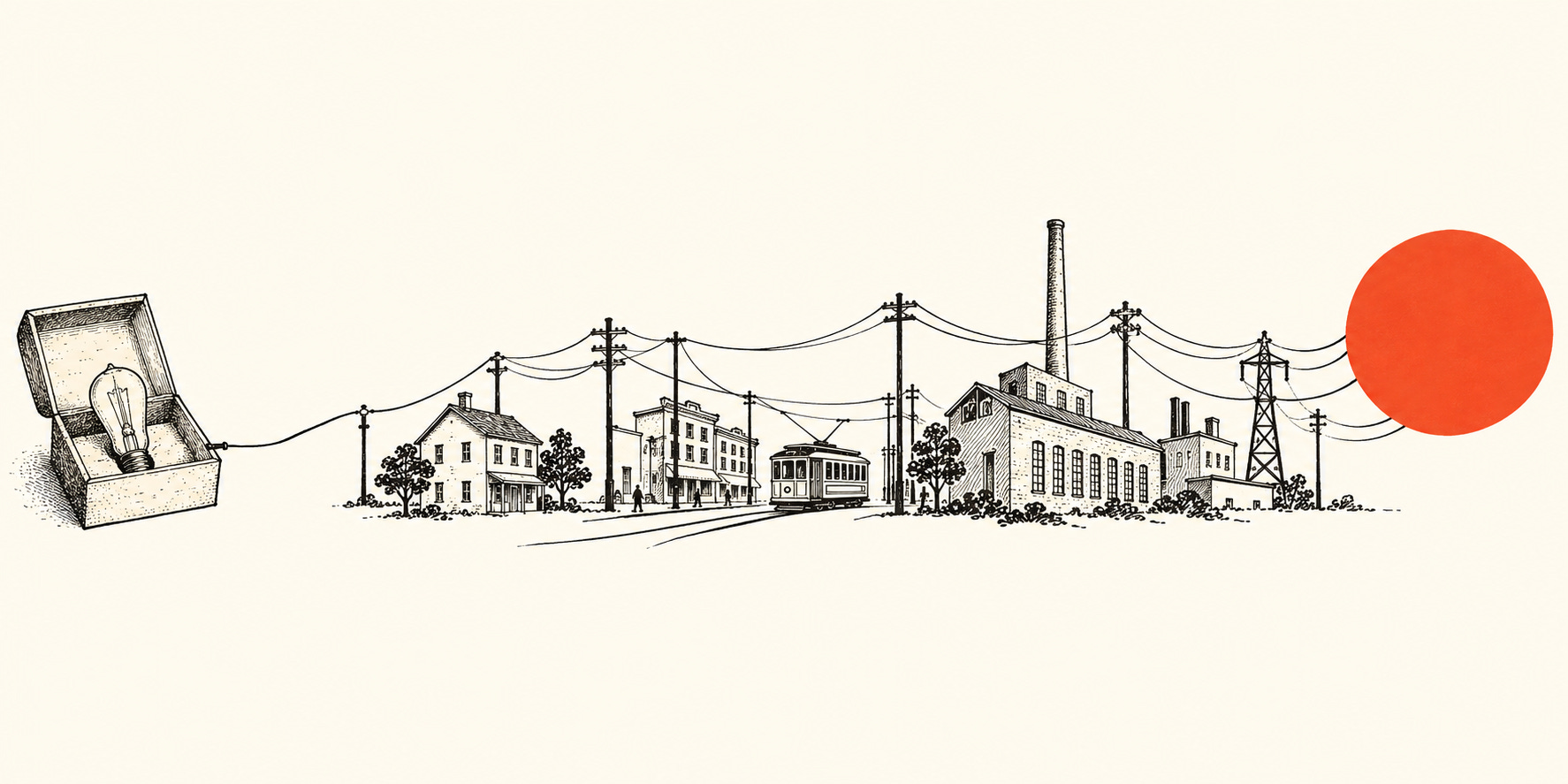
We’ve reached a tipping point. And I think I understand how Thomas Edison must have felt, realizing he made a glaring error back in 1878. That was when Edison incorporated the Edison Electric Light Company—named, sensibly, for electricity’s first commercial application. Fourteen years later, “light” was gone from the letterhead. By 1892, electricity was no longer a product you bought; it was a substrate the entire industrial economy was reorganizing itself around, and the company became General Electric—because light had become too small a word for the thing. It was a reckoning with a name the business had outgrown. Real estate is now stepping into this same kind of reckoning.
Over the past six weeks on this ledger, I’ve been circling something without quite landing on it. I launched this Substack with five predictions for the next 60 months. In my post about Naming Rights, I argued that the market prices a category only after it has been named—and that the great fortunes in real estate have gone to whoever owned the asset in the interval before the naming. And in Four Story Nation, I argued that autonomy, robotics, and AI are attacking the proximity tax that has organized the American city for a century.
Before I go further, a confession. My firm Fifth Wall only begrudgingly adopted the moniker of “PropTech fund” years ago. I have, at various times, leaned into the word and at other times tried to put distance between us and it, because it has always felt, in its way, a little gimmicky and lazy. But still: It was a one-word description that got the point across, and so we went with it. I recognize how odd it is for the person who runs the largest PropTech fund out there to be doubting the appropriateness of his own naming convention. Odd—but, I’ve come to believe, overdue.
Here is why. The term has become extremely expansive: It now gets stretched over everything from a tenant app to a gigawatt of powered land. And it has collided with a deeper shift—it is no longer possible to talk about anything heretofore called “tech” without also meaning AI.
Whatever its original appropriateness, PropTech is now, by definition, AI + technology + real estate: three of the largest forces in the economy compressed into one casual portmanteau.
So when people say “AI is coming for real estate,” they are actually describing five distinct dynamics—five phenomena, that all share a technology and almost nothing else, and that I keep watching smart people talk past each other about.
The word I helped champion is failing us, and the failure has a famous precedent. More on that at the end. First, the five phenomena you need to know about.

01 · AI-native operators, or: Reinventing the old
An enormous number of companies have correctly identified that real estate has been among the slowest and latest adopters of technology of any major industry—and concluded that the fastest way to fix it is not to sell the industry software but to become the industry. These are AI-native real estate operating companies: brokerages, managers, lenders, servicers using AI to render efficiencies across the hundred unglamorous processes it takes to do real estate, or simply to manage assets. The animating thesis is the venture zeitgeist of the moment: don’t sell the software, “sell the work.” I think many of these companies will be successful—the diagnosis is right and the margin math is real. But the field is crowding fast, and crowded fields have a way of competing away the very efficiencies they were founded to capture. Right idea. Rush hour.
02 · Rewiring the incumbents
The second dynamic is AI helping the existing giants of real estate get better—at AI, and therefore at themselves. This is, candidly, where Fifth Wall has always lived. Our original pitch to real estate CEOs was almost impolite in its simplicity: draft off the innovation economy. Venture capitalists are providing free R&D to an industry that never spent on R&D—so adopt what they build. That imperative worked, and it built the firm.
AI inflects it. The opportunity is no longer adopting point solutions from the outside in; it is changing the internal organs of the company wholesale. AI blurs the line between the work humans need to do and the work machines can do. And it is breaking one of the industry’s most expensive articles of faith—that every company must build its own data lake and its own data models. That is one reason Fifth Wall built Antares, which now builds the generative and agentic AI infrastructure for a growing number of the most ambitious real estate companies in the world. The free R&D is still free. It’s the dosage that changed.
03 · Real Estate for AI
The third dynamic inverts the first two. It is not technology for real estate; it is real estate for technology—companies, new and old, doing real estate for the AI infrastructure buildout itself. Every developer of data centers, every neocloud renting out GPUs, every assembler of powered land: the new names like Volta and Crusoe alongside the legacy giants like Digital Realty and Equinix. Digital Realty has been a Fifth Wall LP for years. This is the one dynamic of the five the market has already named—data centers were one of the four asset classes in Naming Rights—and what has no name yet is underneath: the powered land, and the companies assembling it. It also contains the great poetic irony of real estate in this decade: the thing that appears most ethereal—the ether of synthetic intelligence itself—terminates in the most terrestrial things we have. Land. Power. Gigantic computers. Intelligence, it turns out, has a street address.
04 · Edge Industrial
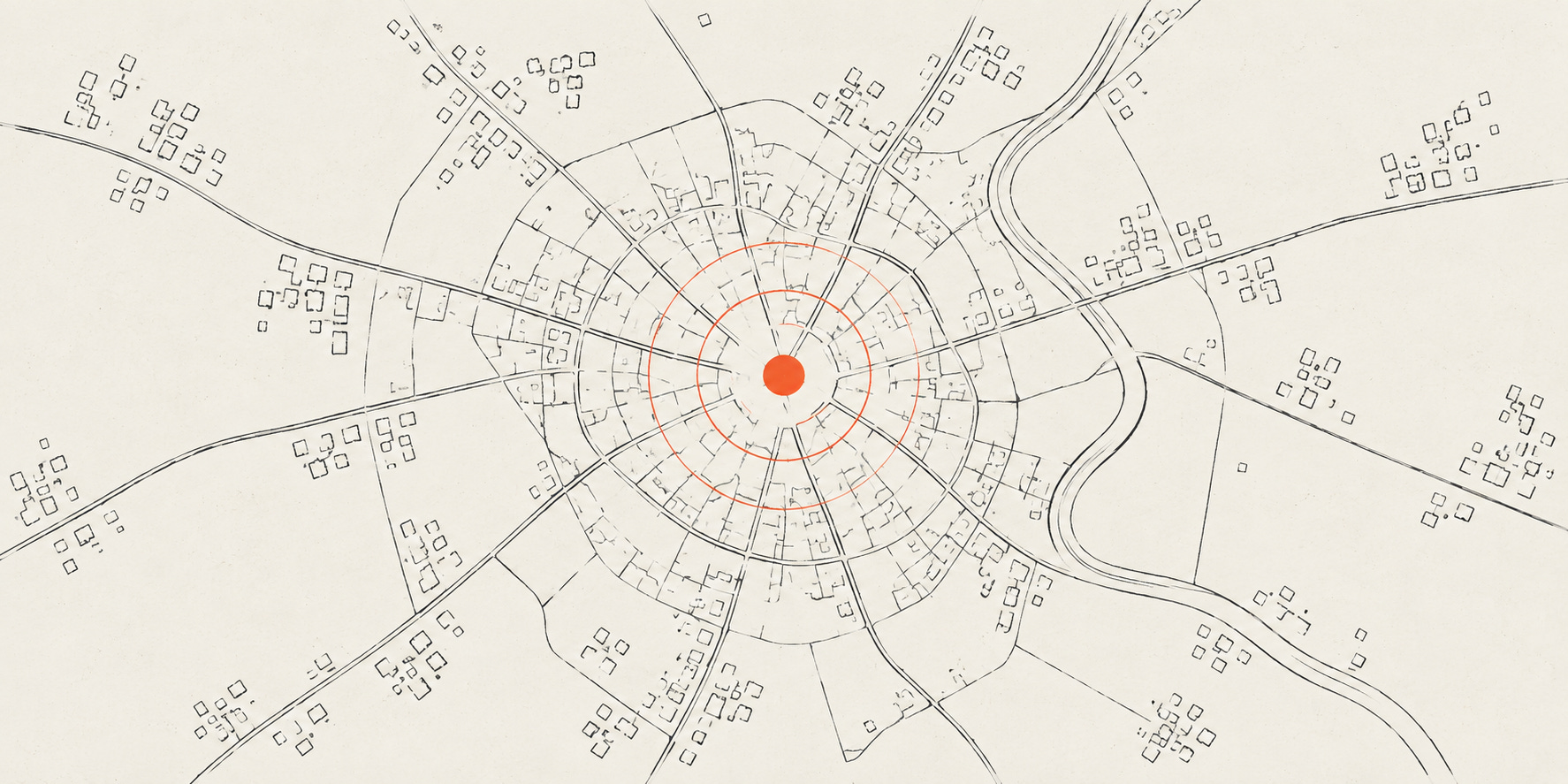
The fourth is the one I began mapping in Four Story Nation, and the one I will go deepest on in the months ahead. Physical AI—autonomy and robotics loose in the world—is moving industrial demand back inside the city. For a century, two assumptions held: cities sprawled outward, and the industrial economy was exiled to the exurban frontier, kept on the edge, out of sight. When machines do the work, both assumptions break at once. In that essay I argued these technologies expand the effective supply of usable proximity; edge industrial is what moves in when they do — industrial activity returning to the city, denser, more vertical, closer to the consumer it serves. The full thesis is coming; consider this a placeholder on the ledger. It is already the conviction behind the largest investment in Fifth Wall’s history, the $135M we put behind Atoms. Of the five dynamics, it is the most physical.
05 · The one without a name
The fifth is the hardest to describe, because I don’t yet have a word for it. There is a class of things in the world that individually possess every intrinsic feature of real estate, and that should be capitalized, financed, and traded like real estate, but that in aggregate are too heterogeneous to be. A driveway rented out for storage. A car wash. The mineral rights under a field. Too unique to comp. Too varied to pool, to index, to securitize. The old answer was standardization: force the assets to conform. What AI enables is different: enormous computational power aimed at the heterogeneity itself—a million singular things understood, priced, and financed as one asset class without sanding off what makes each of them singular. Transmutation, not conformity. I’m building this thesis now, and it will get a name. If you’ve read Naming Rights, you know why I’m not rushing: the returns live in the interval before the naming, and for the moment, I am happily living in it.
Retiring ‘PropTech’
Now, back to the word itself.
Of the five dynamics above, only one—charitably, two—fits a purist definition of “PropTech:” software sold to the property industry. A leasing CRM. A tenant portal. A smarter spreadsheet. A digital twin of the boiler room. The rest are something else entirely: real estate created by AI, cities reorganized by AI, asset classes transmuted by AI.
When five phenomena this different from one another share the same name, the name stops being a category and becomes a source of error.
Allocators misprice it. Founders mispitch it. The industry files it, once again, under tech.
And I say this as someone who has profited from the narrow definition. Fifth Wall backed the companies that conformed to the legacy meaning of PropTech—software for the property industry—and they produced some of our biggest wins: Procore, ServiceTitan, Bilt, and, more recently, Higharc.
But from our inception, our other greatest wins were the investments that stretched the Overton window of what PropTech could possibly mean: Lime, Opendoor, Industrious, Metropolis, and most recently Atoms. A scooter company. An iBuyer. A flexible-office operator. A parking business run on computer vision. A robotics company that is, underneath, a real estate company. For 10 years I have watched this one word strain to hold our own portfolio. We’ve finally reached the day it can’t.
PropTech was real estate’s light bulb: a name for the first application. What is arriving now is the substrate phase. So put this on the ledger with everything else, signed and dated: The word “PropTech” will not survive the decade. Not because the category failed, but because the category outgrew its name. The market prices categories only after they have names. Five are forming right now. Naming them before the market does is the entire point of this publication.
The Edison opening is doing more work than it looks. 1892 was a merger with Thomson-Houston rather than a rename. His name came off, he sold out the year after, and the standard that won was Nikola Tesla's. The category outgrew the word and the substrate changed underneath it in the same decade. Naming it right protected him from neither.
You can retire "PropTech" because Fifth Wall is large enough to be found without it. At our size the word isn't a description, it's an address.
One fund read it as software sold to agents and priced us on customer acquisition. We don't have an acquisition problem. We have more than 630,000 REALTORS® in ten states carrying an obligation their own standard purchase contracts already impose — twelve if you count the two that name smart devices and stop there. The contracts define the duty. Nothing defines how you satisfy it: no standard, no artifact, and the CE credit I took in 2024 covered wire fraud and client data, not this. That isn't demand you create. It's exposure that already exists, and the word is what routed them to the wrong question.
#05 has a precondition that isn't compute.
To price a million singular things as one asset class, you have to be able to point at each one — the same one, next year, and in 2040. A driveway isn't a parcel. A car wash is a business and a property. Mineral rights are a severed estate under someone else's address. None of them has an identifier that survives a sale, a renumbering, or a subdivision.
Heterogeneity isn't the hard part. Reference is.
The identifier also has to be empty. The moment it encodes condition or class it becomes a claim, and claims decay — a wrong identifier is worse than none, because people go on trusting it. A VIN doesn't tell you the car runs. That’s exactly why forty years of service records, recalls and title transfers attach to it without corrupting it.
And it has to outlive whoever operates it. We anchor to public blockchain infrastructure for the same reason no manufacturer owns the VIN: if the register is a company database, "this hasn't been altered" is a claim the operator makes about itself. Anchoring doesn't make a record true. It means we can't quietly change one later — which is what lets people who don't know each other finance the same asset.
The interval before the naming may be shorter than the interval before the referencing.
Of your five, which one gets a durable identifier first?