


A scientist once built a paradise for mice in one of the 20th century’s most famous experiments. Everyone with a theory about overcrowding, welfare, television, the internet, or the fall of Rome returns to this proverbial mouse heaven. I’m going to reference it too, for good reason: It illustrates what happens to a population when you remove every cost of living all at once.
In an earlier post here, “Four-Story Nation,” I celebrated the technological solutions that will remove friction. Part two starts with a rodent problem.
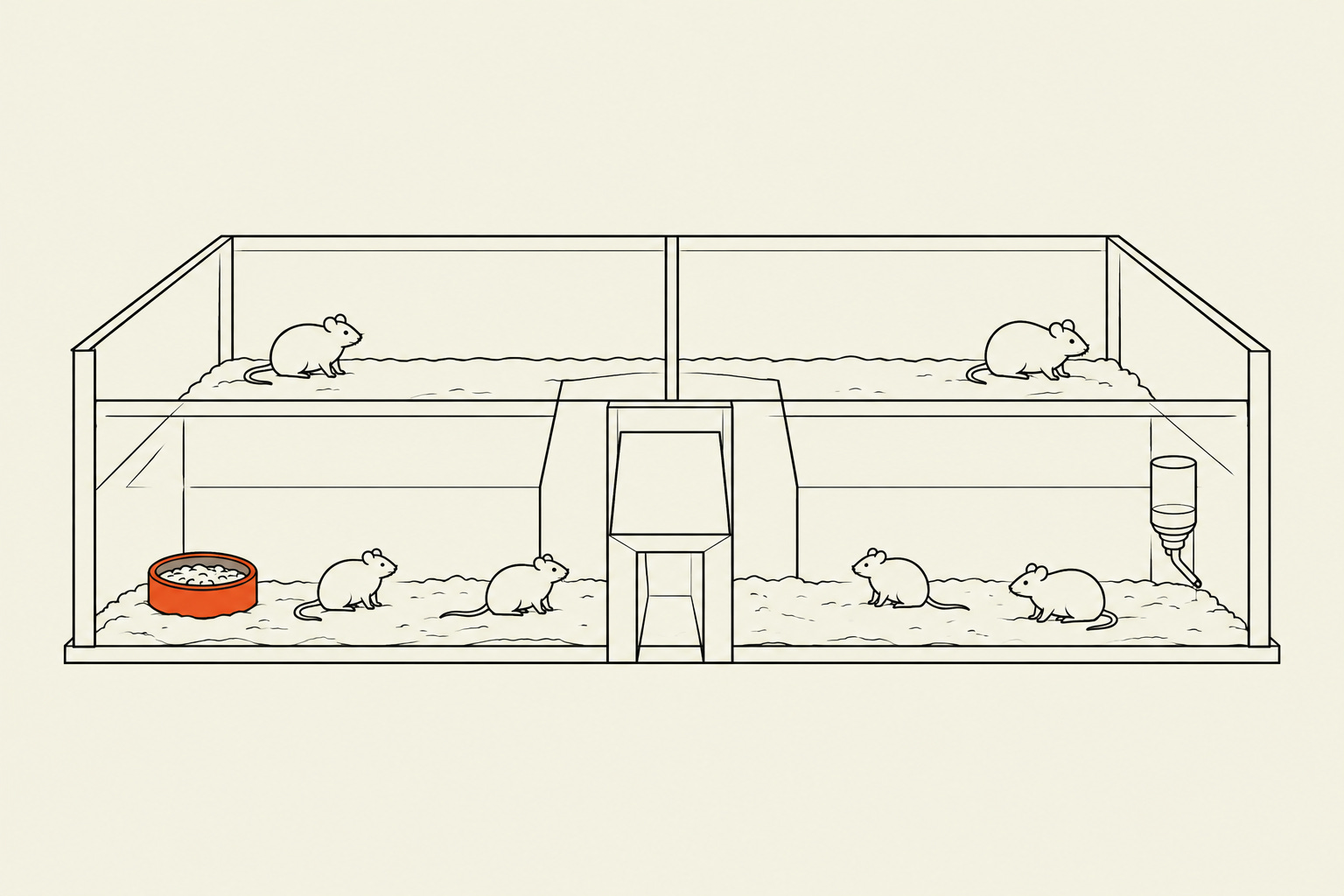
Back in July 1968, John Calhoun put four pairs of mice in a pen at the National Institute of Mental Health in Maryland. The pen had food, water, warmth, nesting space for thousands, and no predators. He called it Universe 25.
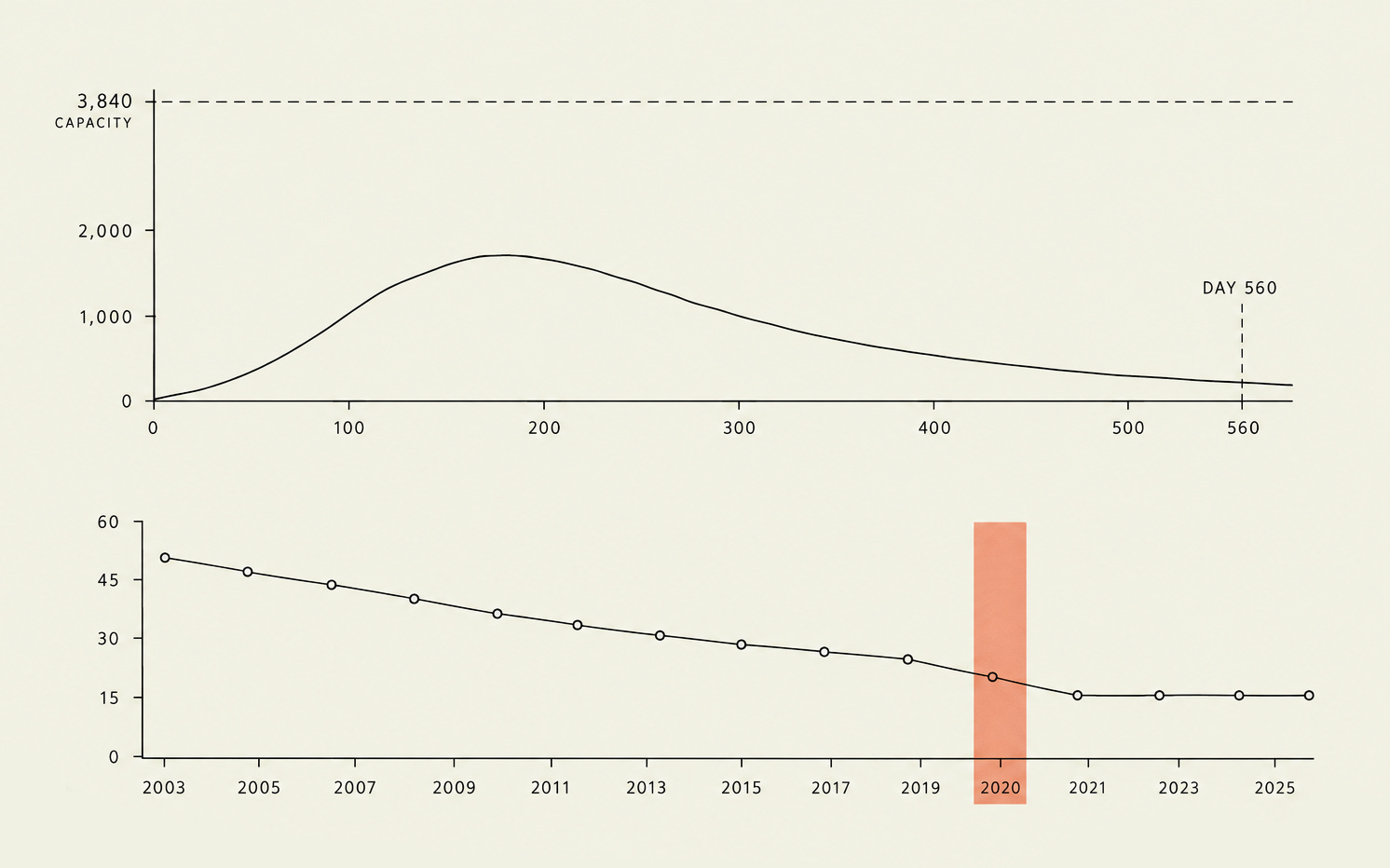
The utopian mouse house had capacity for more than 3,800 residents. But the colony grew for a year and a half, stopped at 2,200 with the pen just over half full, and never grew again. Mice born afterward began exhibiting maladaptive behavior: a class of males, “the beautiful ones,” groomed all day and had no interest in mating. By the time Calhoun published the study in 1973 as “Death Squared,” the population was in terminal decline.
Every cost was removed at once, and the colony withdrew from itself.
In the same Substack essay, I also argued that AI, autonomy and robotics will slash the proximity tax, the premium every household pays to live inside the 30-minute ring around jobs. It is a bold prediction, and still I can’t stop thinking about a lingering counterpoint. The proximity tax was a cost. It was also why people left the house at all.
Commutes are not good, and the stranger on the train is not a gift. But for all of recorded history the costs of being near other people did a second job nobody assigned them. They selected. The people in the room had paid to be in the room. The bar was full of people who had walked there. Friction reveals preference, and preference is one of the most important inputs an economy has. It is how a city learns who wants what.
It had another important byproduct: It brought people to the sidewalk. People walking to the bar inevitably interacted with other people along the way.
None of this was designed. No scientist or urban planner strategized it. We inherited it, the way we inherited sprawl and poured concrete around it without realizing it was doing any work.
The price we pay for nearness
I wrote to our investors the week Lime went public that everything we call urban value is, at bottom, a price paid for proximity to something.
It is also true of people. The luxury of proximity has always been expensive. Being near your workplace, or near a favorite neighborhood. Some of it shows up in rent—higher rents for easier access. The rest of the tab we pay in inconvenience. We go out in the world to run our errands. We commute. And we interact with people and businesses along the way. That hidden work, of interacting with the outside world, is where the city happens. Where urban life takes shape. Where a city’s culture unfolds.
Georg Simmel addressed this cost in 1903, in The Metropolis and Mental Life, positing that the reserve a city demands of its people is the price of the freedom it gives them. Then Jane Jacobs supplied the mechanism in her 1961 critique, The Death and Life of Great American Cities—remembered for the sidewalk ballet, the morning on Hudson Street where the locksmith, the butcher and the moms with strollers each enter on cue. What we forget is that the ballet was made of daily errands—all byproducts of trips taken for other reasons.
Jacobs argued that you cannot build the byproduct. You can only build the reasons and let it come. What if we tested her theory in reverse?
Three technologies: their blessings and their curses
Autonomy, robotics and AI each remove a source of friction.
With a robotaxi you no longer have to drive to get somewhere. With a delivery robot you no longer have to go at all. With AI you no longer have to be in the room to do the work. That is the blessing, and my aforementioned “Four-Story Nation” essay was about just that: Land 45 minutes out starts to count as close, the ring around the jobs gets wider, and the price of living near them falls.
The drive, the errand and the meeting: each technology removes an occasion on which a person had to leave the house—an act that put people on the city sidewalks as a byproduct—and the occasions were the mechanism Jacobs described. When the mechanism goes, the behavior goes with it. In other words, take away the reasons for the trips and you take away everything that rode along with them.
I wrote that our society’s constraint wasn’t the distance of a commute. It was the misery. I should clarify that this “misery” played an important role. A 40-minute grocery run is why you ran into your neighbor. A commute that takes an hour is why you had work friends instead of just coworkers. Remove the strain, and you remove the serendipity. All that is left are empty cubicles and a ballet streamed online.
While it is tempting to blame a global pandemic, the numbers suggest this shift was underway before we all had an excuse to stay in.
The average American now spends an hour and 39 minutes more at home each day than in 2003, and the increase is largest among the younger generations. Americans socialize less in person than they did 20 years ago—and that decline started before COVID lockdowns.
Forged in friction
People between 40 and 55 came of age when you had no choice but to go to things—no recource but to show up.
We made our friends in rooms we did not choose, at jobs we had to commute to, in cities we had to live in because that is where the work was. We did not get to opt out of the stranger. Our social lives were forged in friction.
But the friction was useful.
The generations behind mine have successively more digital freedoms than I did, and they exercise these rights by removing social risk increasingly—maybe even entirely. Nobody got weaker. But the default moved.
The same thing is visible in how people find each other. Online dating is now the most common way American couples meet, ahead of friends, work, church and the bar.
A good share of those matches came at the expense of the nights that used to produce them the slow way: the parties, bars and events a person had to dress for, travel to and risk something at. Each was a small act of overcoming friction. Each was also a room. The app removed the friction and kept the match. What it could not keep was the room, and the room was where everything else happened. Again, friction is still friction. A night at a lame bar could arguably be a worse or less useful experience than staying home with Netflix. But the loss of that friction compounds, in ways we are only now beginning to grapple with.
Increasingly, we find ourselves staying in or going alone, because staying in or going alone are frictionless. And between robotaxis and delivery drones, this increase will only get steeper. Less friction. At what cost?
The objection
I realize skeptics have objected to every new technology, and they have almost always been wrong. The telephone would end the social call. The car would ruin the neighborhood. Television would rot the brain. Each time, people found new reasons to retain the best parts of the old ways of doing things. They opted into serendipity. They opted into peopling the sidewalks. They opted into participating in a city as it happens.
I would counter that the city is one of humankind’s most adaptive inventions, and new occasions may emerge that no one, armchair sociologists included, can conceptualize.
I am also trying to be self-aware that this could read as the nostalgic mourning of a millennial who sees too much charm in yellow cabs, convenience-store runs and the Blockbuster aisle on a Friday night. The cab was dirty and the driver was lost. The run to the corner store was a chore. Nobody misses the late fee. Nostalgia is a bad instrument.
I don’t think we need to return to dial-up internet. The question is not whether those frictions were pleasant. The question is whether they were productive. What did they produce?
Each new technological advance removed one barrier and left the others standing, but this next catalyst is the first time three technologies have arrived together. Calhoun did not remove one cost and wait. He removed them all at once. So continuing to feel out this idea of the proximity tax in U.S. cities: If technology expands the supply of proximity, then for the first time since the automobile, a city will have the ability to opt into its frictions instead of simply inheriting them.
Cognitive researchers have a term for the brain-boosting benefit that comes from friction in learning: desirable difficulty. The old frictions were difficulties that burdened us. The next decade is about evaluating them, curating them, selectively opting in.
The same question is now coming for every institution that once ran on obligation and is about to learn whether it can survive on desire alone. This behavioral dilemma, or optimization for paradise, will define urban design for the next decade. Which costs do we choose to keep?
This is the work of the next decade in urban design, and it is sociology before it is architecture. The question is which costs to keep. Zoning does not answer it. A city might decide to keep its errands: storefronts you can walk to, a cap on how much of the curb the delivery robot gets, a price on the autonomous trip so that some trips still need a person to show up.
A company might decide, as mine has, that its people should commute because the room at the end of the commute is worth it. This requirement is not added misery. You might say I’m biased—I head the company that made the call—but I’ve already put a lot of money on this bet and I’ll double down on the prediction: I think these are choices being engineered on account of a value for a city that was built on friction and thrived on it, and a bet that the right amount of what we oversimplify into misery is a form of desirable difficulty for everyday living.
Ledger Entry 14: Within this experiment’s 60-month window, one of the 10 largest metros in the United States will cap robotaxi or autonomous-delivery density by ordinance, and the stated reason in the council record will be street life, not safety. Safety caps will come first and do not count; every new transportation technology gets those. I am predicting this will be the first time a major American city writes down that it is keeping some of the cost of showing up on purpose. If no metro in the top 10 has done that by August 2031, I was wrong, and people wanted the frictionless city.

Back to the pen. Calhoun designed a habitat for 3,840 mice, and the colony stopped growing at 2,200, with the pen nearly 60% full.
He gave them everything at once, and they withdrew from each other and stopped trying.
Whether that was comfort, crowding, or something unique to mice still gets debated, and I am not going to settle it here. What is not debated enough is what the mice could not do: see the pen. They didn’t have to reckon with the walls. We are about to be handed the same gift, every cost removed in the same decade. The difference is that we can see the pen while we’re inside it.
Cities are built on friction. The technologies I have encouraged are about to remove most of it, and the next decade’s work is deciding which of it to keep. The mice were never going to choose their frictions. To keep succeeding at this great experiment, I think we need to choose ours.